
Research & publications
20 peer-reviewed publications in leading cardiology journals, a book chapter, and active research as Co-Principal Investigator — spanning complex coronary intervention, device therapy and structural heart disease.
Peer-reviewed publications
Balloon venoplasty in collateral-assisted venous remodeling to facilitate LV lead delivery in complex anatomy
In a woman with ischaemic cardiomyopathy (EF 23%) needing a CRT-defibrillator, a hairpin lateral vein blocked LV lead delivery. Using a collateral to build a retrograde rail and sequential balloon venoplasty, the lead was placed — narrowing QRS from 160 to 120 ms with symptom improvement at one month.
Effect of dapagliflozin on indices of atrial myopathy in rheumatic heart disease
Rheumatic heart disease causes left atrial stretching, inflammation and fibrosis that create a substrate for atrial cardiomyopathy, yet standard treatment does not address this remodeling. In patients with moderate rheumatic mitral valve disease, the SGLT-2 inhibitor dapagliflozin significantly improved atrial electromechanics, LA strain and premature atrial contraction burden — pointing to an anti-inflammatory, anti-remodeling and antiarrhythmic role for SGLT-2 inhibitors in RHD.
Vanishing stent phenomenon on OCT in a mycotic coronary aneurysm: a case report
A case report documenting a “vanishing stent” appearance on OCT within an infected (mycotic) coronary aneurysm. It describes the imaging findings and the challenges of managing this rare complication.
Effects of dapagliflozin on left atrial ejection force in HFpEF (DAPA-LAEF trial)
This trial examined whether the SGLT2 inhibitor dapagliflozin changes left atrial ejection force in heart failure with preserved ejection fraction. It adds to the understanding of how these drugs influence atrial function in HFpEF.
Systemic immune inflammatory response index (SIIRI) in acute myocardial infarction
This study evaluated the systemic immune-inflammatory response index as a marker in patients with acute myocardial infarction. It explores whether this simple blood-derived index carries prognostic information after a heart attack.
Decoding Gitelman syndrome in a structurally normal heart with polymorphic VT
A case report linking Gitelman syndrome, an inherited electrolyte disorder, to polymorphic ventricular tachycardia in a heart with no structural disease. It underscores the value of finding reversible metabolic causes of dangerous arrhythmias.
The hidden spark: Gitelman syndrome triggering polymorphic ventricular tachycardia
A 60-year-old woman with a structurally normal heart and no QT-prolonging drugs had recurrent syncope from polymorphic VT driven by Gitelman syndrome. The report argues that persistent hypokalaemia or hypomagnesaemia with unexplained polymorphic VT should prompt electrolyte correction, which can resolve the arrhythmia and may avoid ICD implantation.
Yeo’s index for mitral valve assessment during percutaneous transvenous mitral commissurotomy
Assessing rheumatic mitral stenosis by planimetry, pressure half-time and the continuity equation has limitations. This prospective study validates Yeo’s index — combining anatomic and hemodynamic severity — as a simple, reproducible tool before and after PTMC, showing strong correlation with conventional parameters and excellent agreement with 3D transesophageal echocardiography, while remaining accurate even in patients with atrial fibrillation.
Double kissing mini-culotte stenting in unprotected distal left main bifurcation under OCT guidance
This study reports a double-kissing mini-culotte two-stent strategy, guided by optical coherence tomography, for disease at the distal left main coronary bifurcation. It highlights how intravascular imaging can guide complex stenting in this high-risk location.
Ways to resynchronize the left ventricle in the presence of persistent left superior vena cava
This report describes strategies for delivering cardiac resynchronization therapy when a persistent left superior vena cava complicates lead placement. It offers practical options for achieving LV pacing in this uncommon venous variation.
Primary PCI in an unusual vessel using an unusual technique: a case report
A case report of primary angioplasty performed in an atypical coronary vessel using a non-standard technique during an acute heart attack. It illustrates problem-solving in anatomically challenging emergency PCI.
Epidemiological profile & outcomes of very young & young STEMI patients: NORIN STEMI registry
Drawing on the NORIN-STEMI registry, this study profiles the characteristics and outcomes of very young and young patients with ST-elevation myocardial infarction. It highlights risk factors and prognosis in heart attacks affecting younger adults.
Review of advances on management of chronic thromboembolic pulmonary hypertension
A review summarizing current advances in the management of chronic thromboembolic pulmonary hypertension. It covers surgical, catheter-based and medical options for this form of pulmonary hypertension.
Transhepatic balloon mitral valvotomy in mitral stenosis with interrupted IVC
This report describes balloon mitral valvotomy performed through a transhepatic access route when an interrupted inferior vena cava blocked the usual approach. It demonstrates an alternative access strategy for treating rheumatic mitral stenosis.
Predictive value of apoptotic factor M30 for negative LV remodeling after primary PCI
In 100 anterior-wall STEMI patients, the apoptotic marker M30 (cutoff 81.18 u/ml) independently predicted left-ventricular negative remodeling at 6 months. Measuring M30 early can sharpen risk stratification after primary PCI and flag patients needing intensive anti-remodeling follow-up.
Predictive value of apoptotic factor M30 for negative LV remodeling after primary PCI (TCT Connect-31)
This work assessed whether the apoptotic marker M30 predicts adverse left-ventricular remodeling after primary angioplasty. It explores a biomarker approach to spotting patients at risk of heart-function decline after a heart attack.
Primary PCI in the elderly (age ≥75) Indian population — immediate & short-term results
A prospective study of 50 Indian STEMI patients aged ≥75 (mean 78.3 years) undergoing primary PCI, with angiographic success in 78% and in-hospital mortality of 8%. It concludes primary PCI can be performed safely in the elderly with an acceptable complication rate, favouring a transradial approach.
Post-stroke psychosis following lesions in the basal ganglion
Two elderly women developed delusions and hallucinations after strokes with basal-ganglia lesions on imaging, illustrating often-missed post-stroke psychosis. The authors urge active evaluation for organic stroke risk factors and consultation-liaison psychiatry for timely diagnosis and treatment.
Book chapter
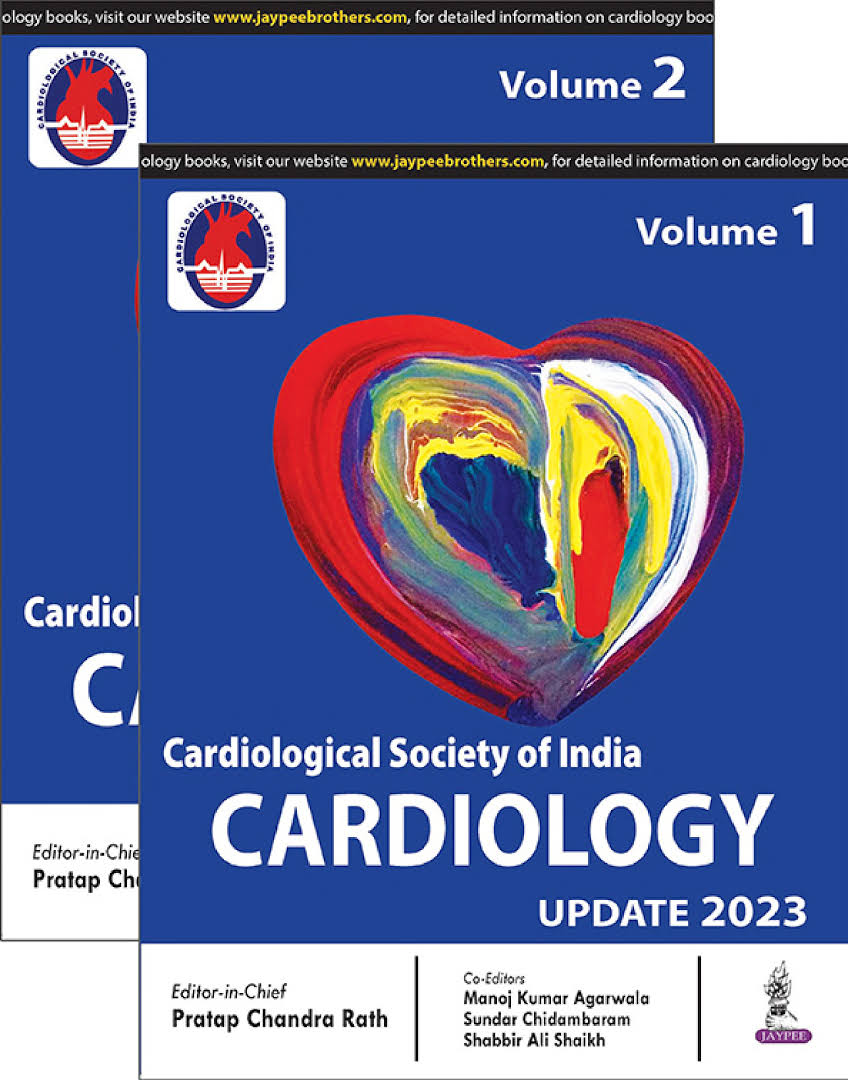
Advances in Management of Chronic Thromboembolic Pulmonary Hypertension
Selected oral presentations
Faculty invitations and oral presentations at India Live, CSICON and CSI Delhi Branch are now collected, with links to each event, on the dedicated conferences page.